
PRX-T33 vs. BioRePeel: Which peel is right for you?
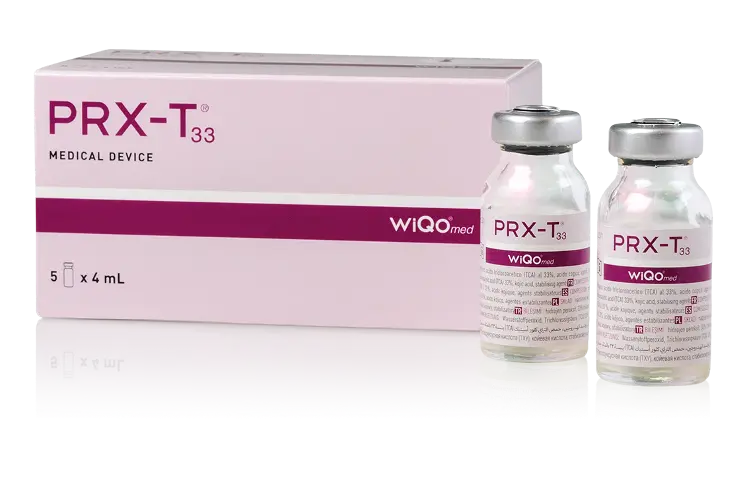
Table of Contents
Peelings are among the oldest methods of skin renewal. However, classic chemical peels often involve visible peeling and days of recovery. PRX-T33 and BioRePeel take a gentler approach: visible results without the typical peeling and without downtime. At alestetics in Zurich, we work with both – which one is suitable in individual cases depends on the skin goal and skin type. Here you can read how they work and how they differ.
PRX-T33 – Biorevitalisation without peeling
PRX-T33 is a non-ablative peel: it works in depth without removing the top layer of the skin. This is made possible by the combination of three active ingredients:
- 33 % Trichloroacetic acid (TCA) – stimulates fibroblasts to form new collagen
- Hydrogen peroxide (H₂O₂) – buffers the acid on the surface so that no visible flaking occurs
- Kojic acid – supports a more even skin complexion
Unlike a classic TCA peel, PRX-T33 does not strip the outer skin layer but stimulates the dermis from within. In a pilot study, this blend of TCA and hydrogen peroxide improved sun- and age-related skin damage (Biron et al., 2022). Read why collagen is the key building block and when it starts to decline in Building collagen.
PRX-T33 is ideal for loss of firmness, fine lines, and a tired, uneven complexion — on the face, neck, décolletage, and hands. Because it does not break the skin surface, the risk of pigment changes is low, even on sensitive or darker skin. The session takes about 30 minutes: cleansing, one to two massaged layers, rinsing, and skincare — with no redness or peeling. Read more on the PRX-T33® page.
BioRePeel – Two-phase exfoliation and care
BioRePeel is a biphasic peel: a lipophilic protective phase and a hydrophilic active ingredient phase. The protective phase coats the skin, strengthens the barrier and reduces irritation – which is why BioRePeel is also suitable for sensitive skin. The active ingredient phase combines:
- 35 % TCA with fruit acids and salicylic acid (AHA/BHA/PHA) – for exfoliation and cell renewal
- Amino acids and vitamins – nurture and support regeneration
- GABA – for a smoothing effect
BioRePeel exfoliates and biostimulates in one step. It is particularly suitable for blemished, acne-prone skin, enlarged pores, and a tired complexion. Mild peeling for one to two days is possible, but not the norm. More on this on the treatment page BioRePeel®.
PRX-T33 vs. BioRePeel – the direct comparison
| Characteristic | PRX-T33 | BioRePeel |
|---|---|---|
| Type | Non-peeling biorevitalization | Biphasic peel |
| Focus | Firmness, elasticity, complexion | Exfoliation, Pores, Glow |
| Active ingredients | 33 % TCA + H₂O₂ + kojic acid | 35 % TCA + AHA/BHA/PHA + amino acids + GABA |
| Especially with | Mature skin, reduced firmness | blemished skin, pores, dull complexion |
| Flaking | None | Rare, mild (1–2 days) |
| Season | all year round | all year round |
Which is better suited, we don't decide based on trend, but on your skin goal – ideally based on the AURA 3D skin analysis.
Both as preparation for microneedling
PRX-T33 and BioRePeel pair well with other treatments. At alestetics, we follow a simple rule: peel before needling. A peel cleanses and exfoliates the surface so the needles penetrate more evenly. Studies show that combining a chemical peel with microneedling improves acne scars more than either method alone (Review article, 2025). Read how we do this under SkinPen® Microneedling.
Why PRX-T33 and BioRePeel at alestetics?
Both peels deliver visible results with no downtime – you can go straight back to your daily routine. Both are possible all year round, including in the summer, and are suitable for most skin types. We will determine together which one best supports your skin goals – ideally based on a skin analysis.
Book your free AURA 3D skin analysis – non-binding, booked in two minutes.
What is the difference between PRX-T33 and BioRePeel?
Does the skin peel after exfoliating?
Can I do PRX-T33 or BioRePeel in the summer too?
How many sessions will I need?
Sources & Studies
The statements in this article are based on the following scientific publications:
- Gold MH et al. (2022). Treatment of Mild to Moderate Facial Chrono- and Photodamage with a Novel Intense Liquid Trichloroacetic Acid Peel. J Clin Aesthet Dermatol. PubMed 35309276
- Woźna J et al. (2025). Chemical peeling in combination with microneedling versus chemical peeling or microneedling monotherapy in the treatment of acne scars: a systematic review and meta-analysis. Advances in Dermatol Allergy. PubMed 41640476

Written by
Alexandra Stroganova
Founder of alestetics® · Pre-ageing specialist
Medical cosmetologist · Certificate of competence V-NISSG · Lymph therapist · since 2021
Alexandra founded alestetics® in Zurich in 2021. She works according to the ‘pre-ageing’ philosophy: improving skin quality early on, rather than trying to conceal it later.
Find out more about Alexandra and the team →