
„We discussed my skin concerns after analyzing the results from my facial skin photos and developed a plan outlining the next steps to address those concerns."
Sekar I. AURA 3D skin analysis with Alexandra
Fresha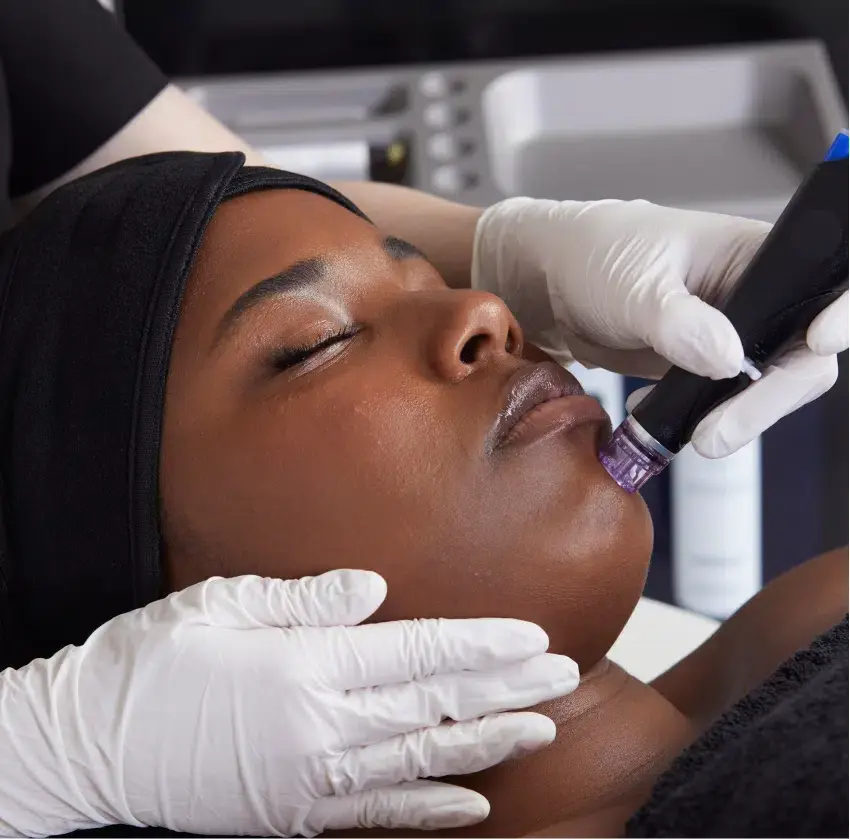
Dehydrated skin isn’t a skin type, but a condition — even oily skin can be dehydrated. The question is where the moisture is lacking and how to actually get it there.
Free AURA 3D skin analysis →CHF 0 · 60 mins · no sales pressure
Your skin feels tight after cleansing — that "clean", tight feeling.
You keep applying cream, but shortly afterwards your skin feels tight again.
Your skin is shiny and flaky at the same time — oily in some places, dry in others.
Fine lines suddenly become more visible, even though nothing else has changed.
Make-up settles into tiny fine lines caused by dryness.
Your skin is more sensitive than it used to be — even to products that used to be fine for years.
Dry skin and dehydrated skin are often confused, but they are two different things. Dry skin produces too little oil — that is a skin type. Dehydrated skin lacks sufficient water in the tissue — that is a condition that can affect any skin type, including oily skin. The skin’s water reservoir is the hyaluronic acid in the dermis; over the years, it diminishes.
Whether the water stays in is determined by the outermost layer of the epidermis — the skin barrier. It functions like a wall: the skin cells are the bricks, held together by a mortar of lipids, primarily ceramides. Around half of the stratum corneum consists of ceramides. If this mortar is intact, water remains in the skin. If ceramides are lacking, the barrier becomes permeable, water evaporates outwards — and the skin becomes dehydrated, no matter how much cream is applied on top.
What weakens the barrier
Most people opt for a richer cream. But creams work on the epidermis, the outermost layer — they barely reach the water reserves in the dermis. They can support the skin’s barrier from the outside, but cannot replenish the moisture lost deep within.
Many people unwittingly make the problem worse. Those who think they have oily skin often reach for harsh, foaming cleansers or daily BHA treatments. However, these don’t just remove oil; they also strip away the skin’s protective lipid barrier. The skin loses more moisture, feels "clean" and tight afterwards — and, in response, produces even more sebum to compensate for the loss. The result: skin that is both oily and dehydrated. You cleanse more aggressively because it looks oily, and this fuels the cycle further. A vicious circle.
Does that mean exfoliation is off limits? No, quite the opposite. Controlled, professional exfoliation is good for dehydrated skin: it removes dead skin cells so that moisture can actually penetrate. The difference lies in frequency and method. A BioRePeel®, for example, exfoliates via a lipophilic phase that preserves the hydrolipid film rather than washing it away — and biostimulates the skin without drying it out. This is completely different from daily aggressive acid treatments at home.
But first things first: rebuild the barrier and let the skin do its job naturally. Less aggression, but instead delivering targeted moisture and building blocks to where the skin stores them — in the dermis. Once the barrier is intact again and the water balance is restored, sebum production regulates itself. That is precisely where our treatments come in.
Dehydrated skin doesn’t need harsh treatments, but rather moisture and nutrients delivered directly to where they’re needed — and a chance for the skin barrier to recover. Listed by their role:
Core treatments
Gently cleanses and infuses hyaluronic acid and antioxidants directly into the skin. Instantly visibly plumper skin, zero downtime — the ideal first step to combating dehydration.
Find out more →59 active ingredients plus hyaluronic acid delivered directly into the tissue. Replenishes moisture right where it’s needed and revitalises the skin at a cellular level.
Find out more →Polynucleotides bind water to the connective tissue matrix over the long term and improve skin density. They not only plump the skin but also stabilise it.
Find out more →Delivers hyaluronic acid and peptides deep into the skin without needles. Ideal if you don’t want needles or if your skin is particularly sensitive.
Find out more →In addition, depending on your skin type
Dermalux™ LED is included in every facial treatment — near-infrared and red light soothe the skin and help the skin barrier to regenerate.
If your skin lacks glow and density in addition to moisture, it’s worth taking a closer look. Skin quality →. The free AURA 3D skin analysis shows you which combination your skin needs. We look at texture, fine lines, and your barrier — and build your plan from that.
Free AURA 3D skin analysis →We measure texture and fine lines and see how your barrier is doing, and whether it’s a barrier or a deep theme. From this, your plan is created. CHF 0, without sales pressure.
We deliver moisture and nutrients deep into the skin and allow the skin’s barrier to rest — rather than putting further strain on it.
We’ll take a look at your home hair care routine (less is often more) and maintain the results with gentle touch-ups.
Pre-Aging is our focus, not a line on the treatment list. Our team has the expertise required according to V-NISSG.
We don’t just replenish moisture; we rebuild the skin’s barrier and let the skin do its own work. Otherwise, the dehydration will return.
Sometimes the best advice is to do less at home. That’s what we’re telling you — even if it means you’ll visit us less often.
Dry skin produces too little oil — this is a permanent skin type. Dehydrated skin lacks water in the tissue — this is a temporary condition that can affect any skin type, including oily skin. That is why skin can feel both oily and tight at the same time. The distinction is important because they require different treatments: dry skin needs lipids, whilst dehydrated skin needs deep hydration and an intact barrier.
Because many cleansers are too harsh. Foaming cleansers and daily BHA acids not only remove oil, but also the lipids that hold your skin barrier together. Studies show that harsh surfactants damage skin proteins and lipids, leading to tightness, dryness and a compromised barrier. The result: the skin loses more water — and often produces even more sebum in response to compensate for the loss. It looks oilier, you cleanse more harshly, and the cycle continues. The solution is not more cleansing, but a gentler, pH-friendly routine and rebuilding the barrier.
This is because UV radiation dehydrates the skin in two ways. UVB affects the surface, damaging the epidermal barrier and increasing water loss — which is what you feel as dryness. UVA penetrates deeper and breaks down collagen and hyaluronic acid, which are the dermis’s own water reservoirs. UVA doesn’t cause a sunburn, so you don’t notice it straight away — but the damage is still happening. A study shows that the sun’s UV rays measurably impair the skin’s barrier function, increase water loss and reduce hydration. Daily sun protection is therefore part of any hydration strategy.
Source: Solar UV radiation reduces the barrier function of human skin. PNAS. 2012;109(42):17111–17116.
A good cream helps — especially one containing ceramides. Around half of the stratum corneum is made up of ceramides, and studies show that skincare products containing ceramides strengthen the skin barrier and reduce water loss. But a cream works on the surface. It does not replenish the water reserves in the dermis — the hyaluronic acid deep within. So a rich cream alone does not solve the problem: you need both an intact barrier from the outside and moisture from the inside.
Source: Kono M et al., Ceramide-containing formulations. The Journal of Dermatology. 2021;48:1807–1816.
Yes — in fact, it’s a good idea. Professional exfoliation removes dead skin cells, allowing moisture to penetrate the skin. The key factors are frequency and method. A professional BioRePeel® protects the hydrolipid film during its lipophilic phase and biostimulates the skin rather than drying it out — quite unlike daily harsh acid treatments at home. The rule of thumb: less frequently, more targeted and under professional supervision rather than daily and aggressively.
Deep hydration treatments like HydraFacial work straight away, but the effects don’t last forever — hydration isn’t a one-off treatment. The results are more long-lasting if we strengthen the skin barrier and replenish moisture reserves with NCTF or PolyPhil over several sessions. Your at-home routine also plays a part. How often you visit depends on your skin — we’ll determine that after the analysis.
This depends on the treatment and the number of sessions — you can find an overview on our Prices page →. Not ready for an on-site analysis just yet? Our Skin Quiz → gives you a quick overview in five minutes — no appointment or email required.

Dehydrated skin is not a skin type or a permanent condition. When the barrier is restored to its full strength and moisture reaches where it belongs, the skin becomes plumper, smoother and more resilient. The AURA 3D skin analysis shows how the texture, fine lines and your barrier are doing. Free of charge, without pressure to buy.
Free AURA 3D skin analysis →CHF 0 · 60 mins · Konradstrasse 1, 8005 Zurich Central Station
Medically reviewed by Alexandra Stroganova, Founder & Pre-Aging Expert · As of: October 2026
Client reviews
Verified booking reviews
690 verified Fresha reviews
Each Fresha review comes from a verified booking through Fresha.
View all Fresha reviews"Perfect, as always." – time and again. For years.
Filter reviews
„We discussed my skin concerns after analyzing the results from my facial skin photos and developed a plan outlining the next steps to address those concerns."
„Laserbehandlung sehr angenehm, schnell und überaus kompetent! (Im Vergleich mit Erfahrungen in anderer Praxis einfach mega!) Ihre Angebote sind massgeschneidert auf Kunde und wohlwollend. Kann ich jedem nur empfehlen."
„exilis w/ katia … great service, very thorough, and super friendly. nice results as well… had already icoon some days before ,-)"
„Ich möchte mich bei katja bedanken das sie mich so freundlich und kompetent beraten hat. Ich kann sie nur weiterempfehlen. Immer freundlich und aufgestellt. So etwas sieht man heutzutage selten. Danke für alles😊"
„Alex was pleasant to speak with and was able to answer all of my questions about my treatments and future treatments."
„Aleksandra was very professional, warm and friendly. I was given great advice for what I needed even though I booked a completely different treatment. All risks and considerations well explained and I never felt 'sold' too. Great consultation… I found my new treatment home."